When the person is the brand
Most brand work starts with a question: who is this business, and what should it be known for?
When the client is a broadcaster with a national profile, that question is already answered by other people, whether she likes it or not.
I have worked with Erin Molan twice. First, on a product brand she founded, and later on the brand she can never sell, which is her own name. The two projects could not be more different, and the difference is the point of this piece.

Chapter one: the product
After her daughter was born, Erin designed a baby singlet that solved a problem every parent knows. Poppers clip the singlet together at the side, so nothing gets pulled over a baby's face or arms. That became By Erin, a range of singlets and bodysuits sold through Babidream, with part of the profits going to charity.
I designed the website for the range. Soft greys and blush pink, handwritten accents, the babies doing most of the work. Erin's own story sat one section down from the products, because on a product site the product comes first, even when the founder is on television every week. Her profile opened doors. The singlet had to close the sale.
I worked on By Erin until Erin sold the brand. That is how product brands are supposed to end, and it is worth noticing what transfers in a sale like that and what does not. The range, the site, the customers, all of it goes with the brand. The name and the profile stay with the person. Which brings us to the second project.
Chapter two: the person
A business can decide what it wants to stand for. A public figure inherits a version of themselves from the media, and the job is not to invent a brand. It is to build something that is unmistakably them, holds its own next to the noise, and works across every direction the career runs.
And Erin's career runs in a lot of directions. A primetime current affairs show. Radio. A newspaper column. Keynote speaking and MC work. Charity ambassadorships. And the advocacy that led to the Online Safety Act, the legislation that the then Prime Minister called Erin's Law.
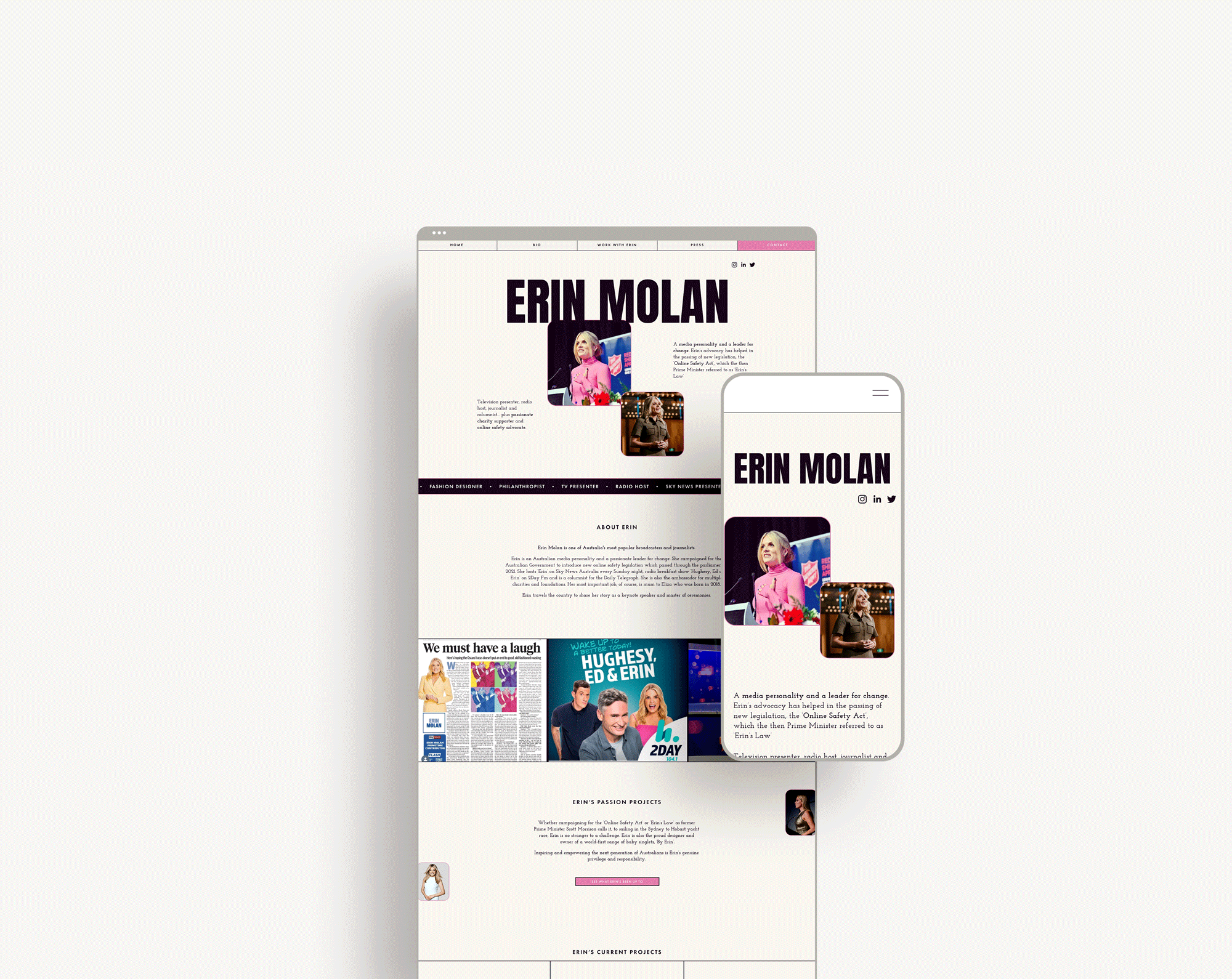
A site serving all of that cannot be a portfolio, a media kit or a personal blog. It has to be all three without looking like a compromise between them. I did the brand direction, the design and build, and the copy, and these are the decisions I would defend:
The name is the logo. ERIN MOLAN runs across the top of the page in heavy black capitals, set like a masthead. A public figure does not need a mark or an emblem. The name is the asset, so the design treats it as one.
The advocacy leads. The first thing the page says is not a list of TV credits. It is that she is a leader for change, with the Online Safety Act named in the opening lines. The credits are everywhere else in her life. The site's job is to say the thing the media profile undersells.
One loud colour. Ink, off white, and a single hot pink, used sparingly and without apology. Confident enough to hold its own next to a broadcast identity, distinctive enough that the site could never belong to anyone else.
The proof matches the buyer. The testimonials on the site are not fan quotes. They are from the Salvation Army, Soldier On and Mercedes-Benz Sydney, the people who actually book her for events. Someone deciding whether to hire an MC needs to hear from someone who hired one.
Everything lands on the booking. Bio, press, projects, every path through the site arrives at Work with Erin. Underneath the editorial surface, it is a booking engine, because that is the thing the site can do that television cannot.
What she said
"I'm so thrilled. I'd hire you a million times over."
Which is generous, and it is also the only kind of result that matters on a project like this. There is no conversion rate on a personal brand. The measure is whether the person feels properly represented, and whether the thing holds up when it is put in front of an audience that already has a view.
The takeaway
Building a brand around a person is the only kind of brand work where the client can genuinely tell you that you got it wrong, because they are the subject. It is uncomfortable and it is the reason the work gets better.
If you are the face of your business, and the website has never quite felt like you, that gap is not vanity. It is a real cost, and it compounds every time somebody looks you up before deciding whether to book you.